*The term “medicine” equally refers to “emergency medicine” and “surgery.”
1989: Reporting for duty!
As a Maxillofacial and Oral Surgery Registrar, I can remember as if yesterday the words of my senior registrar when I walked into the OR on my first day of training. Dr. Thomas Johnston said, “I am going to teach you surgery by SEE ONE – DO ONE – TEACH ONE”, and that is exactly what he did. The first week he operated and I assisted. The next week I operated and he guided me while assisting. Then, by the beginning of the next month, a new junior registrar entered the OR, which made me the senior registrar, and I explained to him how things are going to work: “I am going to teach you surgery by SEE ONE – DO ONE – TEACH ONE!”
This is, of course, the Apprentice Teaching Model, which has been used by barbers over the centuries, teaching their apprentice barbers the finer details of hairdressing, shaving, etc. This is also an indication of the roots of surgery – not in medicine – but in the barber industry during the European Middle Ages*.
*The “era of barber surgeons” generally refers to the period from the 12th to the 18th centuries in Europe, where barbers and surgeons were often the same individuals. They performed a range of tasks, from basic barbering (haircuts, shaves) to more complex medical procedures like bloodletting, wound treatment, and even tooth extraction. This combined role was common due to the lack of formalized medical training and the need for practical medical care, especially in less populated areas.
Starting a new venture in 2007
Let’s fast forward to 2007, and the educational scene for surgeons has changed dramatically! It is also the year when The Apprentice Corporation was formally established.
Surgical training has now moved to primarily simulation training, instead of apprentice-style teaching. Yes, the surgical fraternity has learnt from the aviation industry. Pilots learn to fly and perfect their skills in a simulator. Only when they have perfected their skills and proved that they can handle a variety of emergencies will they be moved to the cockpit of an airplane, of course, under strict supervision and guidance by an experienced senior pilot.
Imagine getting into a large passenger plane and the pilot proudly announces, “Ladies and gentlemen, I have seen how to fly a plane a couple of times, and today I am going to fly this plane for the first time”. Surely, you will be looking for the closest exit door!
The rationale of simulation training
Memory
The three broad categories of human learning based on sensory perception are visual, auditory, and kinesthetic (or tactile/motor) learning. Most medical skills, including surgical skills, fall in the latter category: kinesthetic learning. One cannot learn these skills out of a handbook, and even virtual and augmented reality (while having a role to play) falls short of the goals of learning skills. Motor memory is something that musicians understand a lot better than most other people. Muscles, aided by the supplying motor nerves, will – through training – remember a sequence of functions, and eventually, it will become automated. The constant sensory feedback is of utmost importance.
Learning in a simulation environment takes advantage of kinesthetic learning. It allows the student to reach a certain level of proficiency before being allowed into the clinical setting, like in the ER or OR. It also offers the mentor (I intentionally use the term “mentor” instead of “teacher”) the opportunity to objectively assess the level of proficiency in mastering a particular skill that the student has reached. This gives both the student and the mentor an indication of readiness to begin working on actual patients.
The opportunity to make as many mistakes as you wish!
The simulation environment has another significant advantage: it is super-forgiving! It allows the student to make any number of mistakes on a simulator rather than on an actual patient.
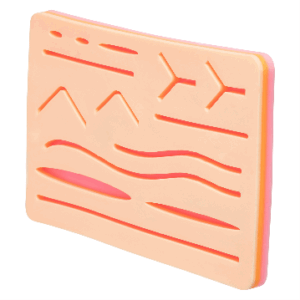
I did my first wound suturing on a patient many years ago, and that was not ideal. Firstly, I was super nervous, and I am sure my patient perceived this. So, I did my best – but it was a far cry from the level of excellence that I wanted to offer my patient. Students should practice their suturing techniques repeatedly, reaching a high level of proficiency, before working on animal or human patients.
Automated response and automated roles
If I wake you up at 3 am and ask you the question: “How do you stop a bleed in an emergency scene?” You should immediately answer: “pressure, packing, tourniquet!” and then sleep further.
Why do one need to learn a relatively straightforward sequence of actions like those used in Cardio-Pulmonary Resuscitation (CPR) and Stop the Bleed (STB) in a simulation setting?
These types of emergencies may be common to the emergency medicine practitioner (EMT/Paramedicine/Emergency Room Physician and Trauma Surgeon). Still, for most other medical and Healthcare Professionals, these types of medical emergencies may never present themselves, or only a few times over a lifetime. To be prepared and to do the right things in the correct sequence, one needs to have automated the response. This only happens by repetition and actual simulation of the emergency in a simulation environment.
In a team setting, each team member also needs to know their specific role and the procedures to follow, and the order in which they should be done. I like to remind my students: Leadership is not taking over – it is ensuring each role player knows what to do and when to do it (and that includes you as the team leader).
Types of medical simulation
There are essentially three types of medical simulation applications:
- Simulation using a basic simulator
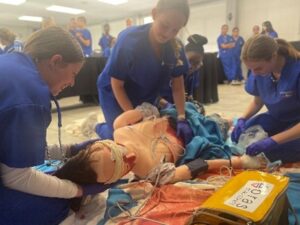
- Simulation using an advanced (intelligent/AI-enhanced) simulator
- Simulate the scene using volunteers
 |
 |
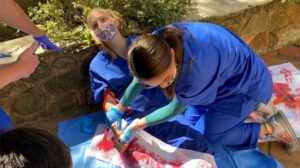 |
| A Suturing practice simulation pad | An advanced trauma simulator (manikin) | Simulate a mass-casualty scene using volunteers |
My own experience: Apprentice Doctor® Events
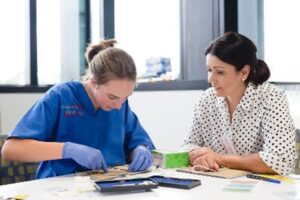
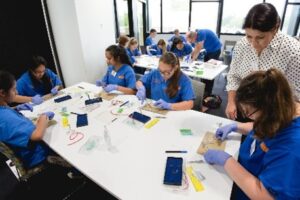
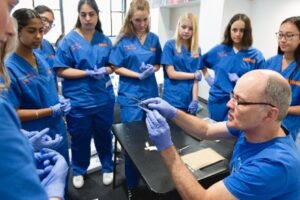
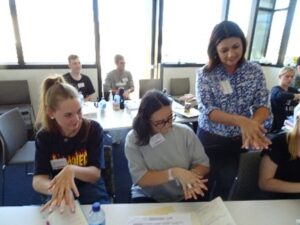
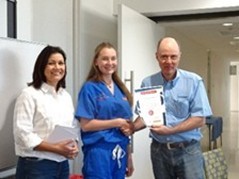
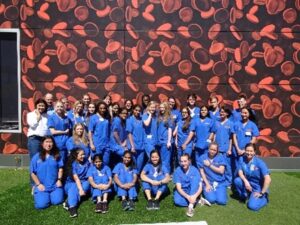
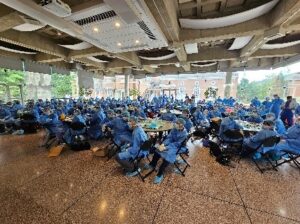
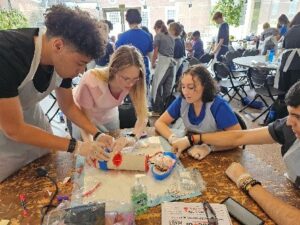
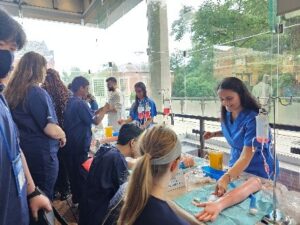
Since the establishment of the Apprentice Corporation in 2007, I have had the privilege of hosting dozens of Apprentice Doctor® Events all over the world. Whether in the US, Australia, South Africa, or Bulgaria, the experience has always been rewarding.
The sparkle in the eyes of a student when they hear their own heart sounds for the first time, or the brightening of their face when they master a complex suturing technique, are brain engram photos that will never be erased from my mind.
To see multitudes of attendees proclaim enthusiastically that they are now certain medicine is for them, or the occasional student who realizes the contrary to be true (I also find this a highly favorable outcome), has been an incredibly fulfilling journey. I am looking forward to see these programs replicated all over the world.
Dr. Anton Scheepers, The Apprentice Doctor®
Vision: The Apprentice Doctor® endeavors to be a positive influence in the lives of future medical professionals worldwide and to enthuse these aspiring medical professionals to reach their goals and dreams.
Mission: The Apprentice Doctor® aims to assist medical professionals globally, whether aspiring, in training, or practicing, with suitable medical and surgical simulation training resources and events.
 |
 |
 |
 |
 |
 |
 |
 |
 |