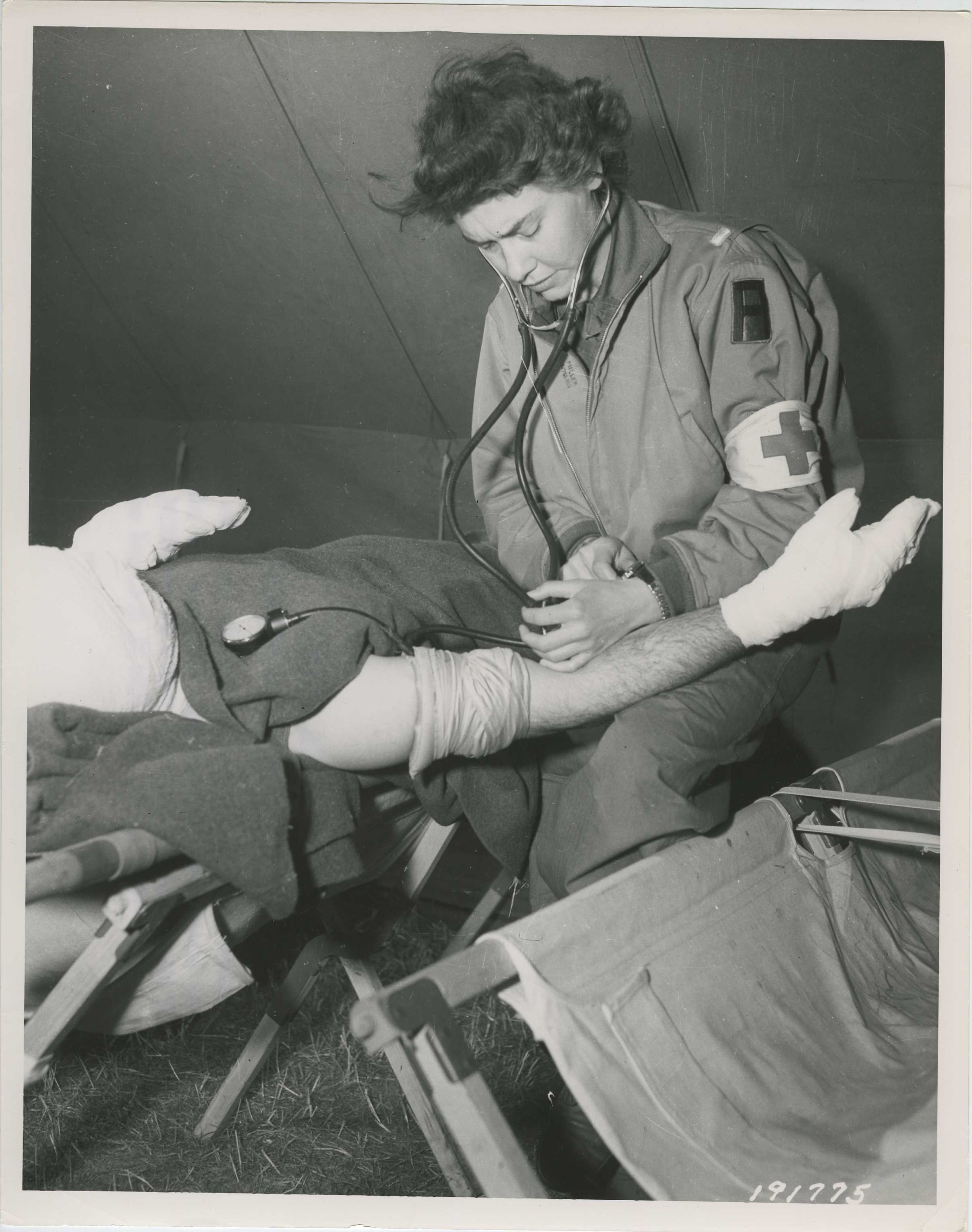
A patient walks into a primary care clinic. Before they ever see the physician, someone takes their history, records their vitals, updates the chart, maybe draws blood, and flags the concern that actually matters. In most US outpatientA patient who attends a clinic or hospital department for assessment or treatment and goes home the same day, without being admitted to a bed. clinics, that someone is a medical assistant.
The role sits at an interesting spot: fast to enter, genuinely clinical, and legally more constrained than most newcomers expect. This piece covers the US picture using 2024-2025 federal data. Pay, training rules, and what you're allowed to do all shift by state, and those shifts are large enough to change your decision.
The career, in numbers and fine print
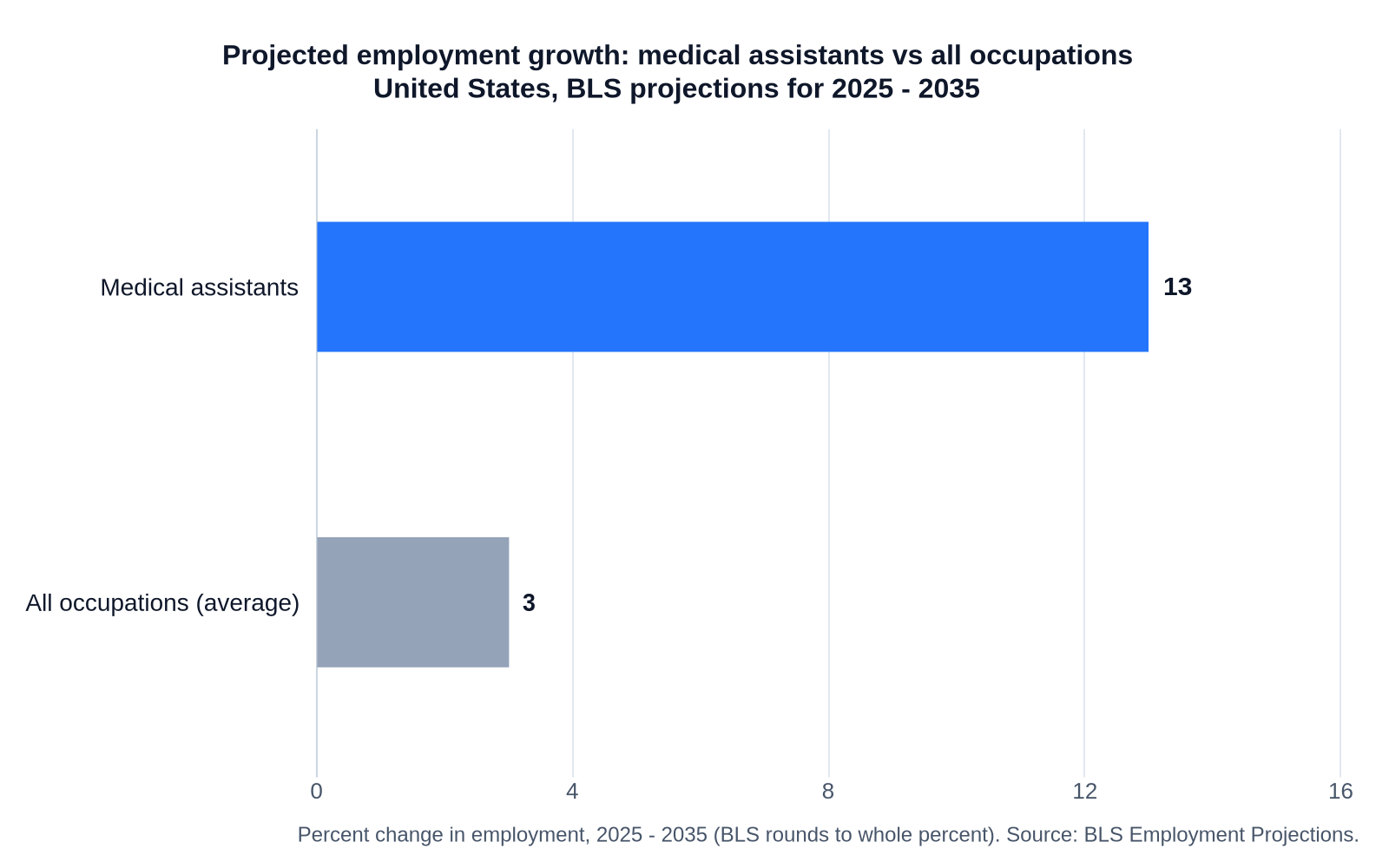
Start with demand, because it's the part that holds up under scrutiny. The Bureau of Labor Statistics projects employment of medical assistants to grow 12 percent from 2024 to 2034, much faster than the average for all occupations, with about 112,300 openings projected each year over the decade. For context, the average growth rate for all occupations is 3 percent. That gap is the whole story on job security.
Two forces drive it. The growing older adult population increases the volume of routine clinical visits, and most of those visits run through a medical assistant, while ongoing expansion of outpatient and ambulatory care shifts care out of hospitals and into the exact settings where MAs are concentrated.
Pay is the more sobering half. The median annual wage for medical assistants was $44,200 in May 2024. Setting matters: the highest paid medical assistants worked at outpatient care centers, where they earned a median salary of $46,090. Geography matters more. The highest paying states in 2023 were Washington, Washington D.C., Alaska, California, and Massachusetts. One 2026 analysis of BLS state data found the lowest-paying states clustered in the rural South, with Mississippi, Alabama, Louisiana, and West Virginia near or below $35,000 median, a swing of roughly $20,000 a year for the same role. The catch that swing hides is cost of living, so don't read the top of the list as free money.
Getting in is quick by clinical standards. The certificate path takes 9 to 12 months, while an associate's degree takes two years, and after finishing, aspiring CMAs take an exam offered by the American Association of Medical Assistants. The credential is worth understanding: the CMA (AAMA) represents a medical assistant who has achieved certification through the AAMA's Certifying Board, tested across general, clinical, and administrative responsibilities. On the BLS-versus-certification question, be careful about causal claims. The BLS does not break down salary data by certification, but medical assistants with a certification are viewed more favorably by employers and are more likely to get hired for higher paying openings. That's an employer-preference association, not proof that the letters themselves raise your pay.
What you can actually do depends on your ZIP code
Here's where the job surprises people. A medical assistant is not a licensed professional. Unlike physicians, nurses, and pharmacists, medical assistants are not licensed; they are certified, and certification is not the same as licensure, which is why the AAMA classifies them as unlicensed assistive personnel under the laws of many states.
That single fact reshapes the career. Because MAs aren't licensed, what you may legally do is decided above you. Each state's medical, nursing, or legislative board determines which tasks can be delegated to an unlicensed individual, and most permitted clinical tasks can only be performed when a licensed provider has specifically assigned them and is on-site or immediately available. The rules are inconsistent nationwide. The legal framework governing delegation to unlicensed personnel varies greatly from state to state, and most states lack laws specifically addressing the practice of medical assisting.
The clearest example is blood draws. In most states, an MA can do venipunctureThe puncture of a vein with a needle to obtain a blood sample for testing or to gain intravenous access for administering fluids or medications. after training and under delegation. But four states, Washington, California, Nevada, and Louisiana, require a separate state-specific phlebotomyDrawing blood from a vein, either to obtain a sample for laboratory testing or as treatment to lower red cell mass or iron load, as in polycythaemia vera, haemochromatosis or porphyria cutanea tarda. credential before an MA can draw blood, and a standard CMA, CCMA, or RMA does not authorize phlebotomy there. One credential, four states where it doesn't cover a core task.
Some limits are near-universal. Starting, managing, or disconnecting IV lines is prohibited for MAs in virtually all states regardless of phlebotomy training. And in one state the ceiling is unusually low: New York has very limited scope of delegation authority to medical assistants, if any.
Reading the role honestly
Line the pieces up and a pattern appears. The job is a fast, well-demanded entry point into clinical work, with modest pay that lives or dies by state and setting, and a scope defined less by your training than by where you happen to practice. For pre-nursing and pre-med readers, that last part is the useful bit: the MA seat is often the cheapest ticket to real patient contact before committing to a longer program.
If you're weighing it, do one specific thing before you enroll: read your own state's delegation and phlebotomy rules, then check the median MA wage for your metro on the BLS state pages. Those two documents will tell you more about your day-to-day than any program brochure.
This article is general education, not personalised career or legal advice. Rules and pay change, and your own decision belongs with a qualified advisor and your state's licensing board.
Sources
- US Bureau of Labor Statistics, Occupational Outlook Handbook: Medical Assistants (May 2024 data; 2024-2034 projections). https://www.bls.gov/ooh/healthcare/medical-assistants.htm
- DiplomaCraft, "Medical Assistant Salary in 2026," summarizing BLS May 2024 data (setting and demand drivers). https://diplomacraft.com/blog/medical-assistant-salary
- Stepful, "Medical Assistant Job Outlook & Demand" (pay by setting and state). https://www.stepful.com/post/medical-assistant-job-outlook
- OpenExamPrep, "CCMA Salary & Career Path 2026," using BLS May 2024 state data. https://open-exam-prep.com/blog/ccma-salary-job-outlook-career-path-2026
- Nursing Education, "How to Become a Certified Medical Assistant" (program length, exam). https://nursingeducation.org/careers/certified-medical-assistant/how-to-become/
- American Association of Medical Assistants, Certification (CMA (AAMA) credential). https://www.aama-ntl.org/certification
- CCI Training, "Medical Assistant Scope of Practice" (licensure vs. certification, phlebotomy states, IV lines). https://ccitraining.edu/blog/medical-assistant-scope-of-practice/
- American Medical Association, "Medical Assistants' Scope of Practice" chart, via Vermont Legislature (state-by-state delegation, New York). https://legislature.vermont.gov/Documents/2018/WorkGroups/House%20Government%20Operations/Bills/H.496/Witness%20Testimony/H.496~Jessa%20Barnard~AMA%20Chart~1-10-2018.pdf