Ask a roomful of first-year students what kills people, and you'll hear plane crashes, shark attacks, and serial killers before anyone says "high blood pressure." The actual leading causes are quieter than that, and they kill on a scale the dramatic ones never approach. In 2024, about three million Americans died, and the top ten causes accounted for roughly seven in ten of those deaths.

A word on scope before the countdown, because scope changes the answer entirely. These rankings are for the United States, all ages, using the CDC's National Center for Health Statistics. In 2024, 3,072,039 deaths occurred in the United States, and the overall age-adjusted death rate was 3.8% lower than in 2023. I'm counting natural causes, so unintentional injuries (third overall) sit outside this list even though they kill more people than stroke. Shift the frame to a low-income country and the picture rearranges: infectious disease and childbirth climb, and stroke outranks heart disease in places like South Asia. Shift to young adults anywhere and overdose, suicide, and trauma dominate. Hold the frame steady, US, all ages, and here are the five, from fifth-most to most frequent.
Part 1: The countdown, fifth to first
The numbers below are CDC provisional 2024 totals. They are stable enough to rank confidently, though final counts may shift slightly.
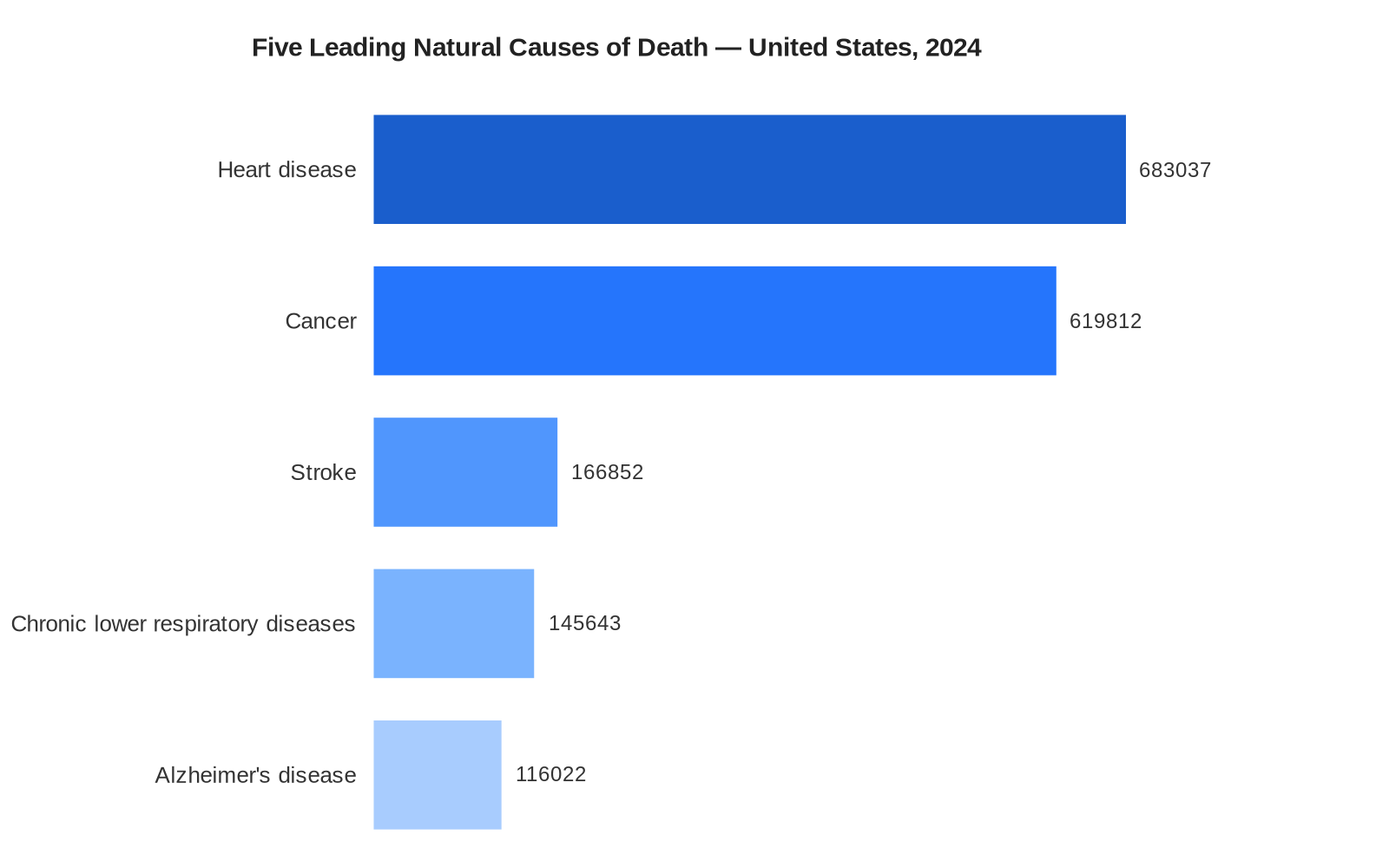
Number five: Alzheimer's disease. Alzheimer's accounted for 116,022 deaths. It earns its place partly through demographics: we keep more people alive long enough to develop it. There's no cure, but the prevention story is more hopeful than most clinicians assume, which I'll come back to.
Number four: chronic lower respiratory diseases, mostly COPD. These caused 145,643 deaths. This is the long shadow of cigarettes, decades after the first puff.
Number three: stroke. Cerebrovascular disease killed 166,852 people. A stroke is plumbing failure in the brain, either a clot or a bleed, and it shares almost its entire risk-factor profile with the disease sitting at number one.
Number two: cancer. Cancer accounted for 619,876 deaths, not one disease but hundreds, which is why no single prevention lever works across all of them.
Number one: heart disease, and it isn't close. Heart disease caused 683,491 deaths. It has been the leading cause of death in the United States since 1950. Globally the dominance is even starker: cardiovascular diseases were responsible for 19.2 million deaths in 2023, up from 13.1 million in 1990.
Part 2: What actually prevents each one
A ranking of killers is just trivia unless you pair it with what moves the needle. For each, here's the single most effective lever, with the evidence behind it and an honest note on its strength.
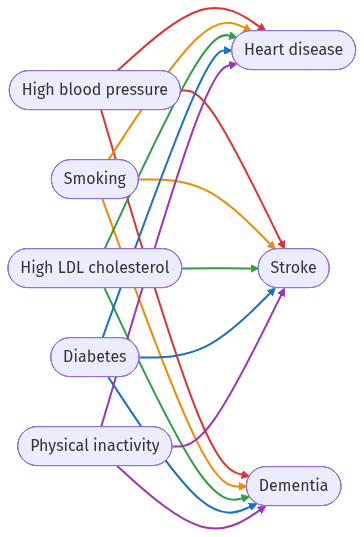
Heart disease and stroke, treated together. They share an engine, so they share a brake. Risk factors for heart disease include high blood pressure, high cholesterolThe principal sterol of all higher animals, distributed in body tissues, especially the brain and spinal cord, and in animal fats and oils., smoking, diabetesA heterogeneous group of disorders that share glucose intolerance in common., overweight and obesity, unhealthy diet, physical inactivity, and excessive alcohol use. Of these, blood pressure does the most damage at the population level. In 2023, high systolic blood pressure was the leading contributor to cardiovascular disease burden worldwide, followed by non-optimal diet. This is well-established, causal evidence from randomized trials, not just association. The practical takeaway is unglamorous: find and treat hypertensionPersistently elevated arterial blood pressure. Thresholds vary by guideline: many define hypertension as sustained readings at or above 140/90 mm Hg, while the 2017 ACC/AHA guideline defines stage 1 hypertension as 130-139/80-89 mm Hg and stage 2 as at least 140/90 mm Hg., because it's common, silent, and cheap to manage.
- Measure blood pressure at every reasonable opportunity, since most hypertension is asymptomatic.
- Treat it to target with generic, well-tolerated drugs.
- Stack the other levers where you can: smoking cessation, LDL lowering, glucoseA primary source of energy for living organisms. It is naturally occurring and is found in fruits and other parts of plants in its free state. It is used therapeutically in fluid and nutrient replacement. control.
Cancer. No single lever covers every tumor, but one factor towers over the rest. An estimated 40.0% of all incident cancers in US adults aged 30 and older in 2019 were attributable to potentially modifiable risk factors. By the American Cancer Society's analysis, 44% of all cancer deaths in that group were attributable to modifiable risk factors. The biggest single one is not subtle. Cigarette smoking had the largest population attributable fraction, accounting for 19.3% of all cases. Smoking contributed to nearly 20% of all cancer cases and 30% of all cancer deaths. For cancer, "prevention" mostly means tobacco control, plus the targeted wins of HPV vaccination and screening that catches disease early.
COPD. Same villain, different organ. The dominant cause of chronic lower respiratory disease is tobacco smoke, and the single most effective intervention is stopping the exposure: quitting smoking, and policy that drives quit rates up. Lung damage doesn't reverse, but the decline slows sharply once the smoke stops.
Alzheimer's and dementiaAn acquired organic mental disorder with loss of intellectual abilities of sufficient severity to interfere with social or occupational functioning. The dysfunction is multifaceted and involves memory, behavior, personality, judgment, attention, spatial relations, language, abstract thought, and other executive functions. The intellectual decline is usually progressive, and initially spares the level of consciousness.. Here's the part that surprises clinicians who assume dementia is pure genetic fate. The 2024 Lancet Commission concluded that addressing 14 modifiable risk factors, starting in childhood and continuing through life, could prevent or delay nearly half of dementia cases. The update added two new factors: about 7% of cases attributable to high LDL cholesterol in midlife from around age 40, and 2% to untreated vision loss in later life. Several of those overlap with the cardiovascular list, which is why blood pressure, cholesterol, and exercise keep reappearing.
Keep two things in mind: Firstly, that 45% is a population-level, theoretical maximum, not a personal guarantee. The risk modification affects the population and does not guarantee that any individual will avoid dementia. And secondly, much of the dementia evidence is observational. We can`t randomize people to decades of high blood pressure, so causationThe relating of causes to the effects they produce. Causes are termed necessary when they must always precede an effect and sufficient when they initiate or produce an effect. Any of several factors may be associated with the potential disease causation or outcome, including predisposing factors, enabling factors, precipitating factors, reinforcing factors, and risk factors. is inferred, carefully, from converging studies rather than proven the way a drug trial proves a drug.
Part 3: The pattern worth carrying into clinic
Line the five up and the redundancy jumps out. Heart disease, stroke, much of cancer, COPD, and a large slice of dementia all respond to a short, overlapping list: don't smoke, control blood pressure, manage cholesterol and glucose, move your body, drink little. In 2023, 79.6% of all cardiovascular disease disability-adjusted life years globally were attributable to modifiable risk factors.
So the patient in front of you with untreated hypertension isn't just a cardiologyThe branch of medicine concerned with the structure, function, and disorders of the heart and blood vessels, including their diagnosis and treatment. problem. That same number is quietly feeding their stroke risk and their dementia risk at once. The unglamorous work, the blood pressure cuff, the cessation conversation, the statin nobody remembers to start, does more against the real top five than any single dramatic intervention you'll learn to perform.
This article is general education, not personalized medical advice. Individual decisions belong with a qualified clinician who knows the patient.
If you're early in training and want to build the bedside skills that make this prevention work real, from taking an accurate blood pressure to running a focused history, The Apprentice Doctor's courses and kits are built for exactly that stage.
Sources
- CDC/NCHS, FastStats: Leading Causes of Death (provisional 2024 figures). https://www.cdc.gov/nchs/fastats/leading-causes-of-death.htm
- CDC/NCHS, Vital Statistics Rapid Release No. 39, Mortality in the United States, Provisional Data 2024 (Sept 2025). https://www.cdc.gov/nchs/data/vsrr/vsrr039.pdf
- CDC/NCHS Data Brief No. 521, Mortality in the United States, 2023. https://www.cdc.gov/nchs/products/databriefs/db521.htm
- CDC MMWR, Mortality in the United States, Provisional Data, 2023. https://www.cdc.gov/mmwr/volumes/73/wr/mm7331a1.htm
- CDC/NCHS, Heart disease deaths, Health, United States. https://www.cdc.gov/nchs/hus/topics/heart-disease-deaths.htm
- Global Burden of Disease 2023 cardiovascular report (ACC/IHME), JACC, Sept 2025. https://www.healthdata.org/news-events/newsroom/news-releases/report-cardiovascular-diseases-caused-1-3-global-deaths-2023
- Islami F, et al. "Proportion and number of cancer cases and deaths attributable to potentially modifiable risk factors in the United States, 2019." CA: A Cancer Journal for Clinicians, 2024. https://acsjournals.onlinelibrary.wiley.com/doi/full/10.3322/caac.21858
- American Cancer Society press release on the above study (44% of cancer deaths). https://pressroom.cancer.org/releases?item=1341
- Livingston G, et al. Dementia prevention, intervention, and care: 2024 report of the Lancet Commission. https://www.thelancet.com/commissions-do/dementia-prevention-intervention-and-care
- EurekAlert summary of the 2024 Lancet Commission on dementia. https://www.eurekalert.org/news-releases/1052982