An ambulance’s siren wails as it drives up to the to the hospital’s emergency room door. Two nurses and a doctor wait as the stretcher is rolled out. The (Emergency Medicine) doctor quickly examines the patient, determines their need – and saves the person’s life.
This can be you! A doctor who daily saves lives; a person who is almost constantly in the midst of high action. Emergency medicine doctors (EMD) work in emergency rooms or trauma centers and treat patients who need immediate care. These professionals specialize in advanced cardiac life support, trauma care and management of other life-threatening conditions. [1]Emergency medicine doctors must be able to make quick decisions and lead a team of other medical professionals during intensely stressful situations. On a daily basis, EMDs…
- Handle Virtually Any Emergency. Trained to handle virtually any crisis, Emergency Medical Doctors (EMD) have the tools needed to begin the management of every acute medical condition or injury that comes their way.
- Make a split second/lifesaving diagnosis. Armed with quick thinking skills and a strong knowledge base, EMDs consistently make accurate decisions that save lives.
There are many advantages of being an EMD, a few of them are listed below:
- See a variety of patients. EMDs see a variety of patients, including: babies and elderly patients; the critically ill and the worried well; pregnant patients and psychiatric patients. In other words, people from every walk of life.
- Have a flexible schedule. EMDs typically work 8-12 hours at a time, with days off in-between. Most EMD practices do not have on-call time, which allows them to have the time to pursue outside interests.
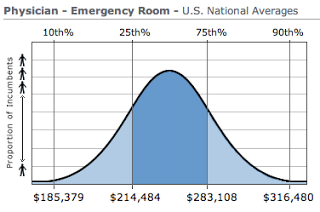
- Earn a decent salary. [3]The median salary for an EMD is $246,452. A small number of EMDs receive earning up to $500,000 or more!
The following image shows the [4]US National Average salary for EMDs:
If you are thinking of becoming an Emergency Medicine Doctor (EMD) you will face many challenges
Do you think you are up to it?
- Stress level. EMDs work very hard, often managing many critical patients at one time. Some patients die in front of them. EMDs see patients who are victims of child abuse, rape, or other terrible situations.
- Difficult patients. EMDs handle more “difficult” patients than most other specialties. Patients and their families are typically under strain from their acute medical conditions and therefore sometimes treat the EMD inappropriately.
To become an EMD you must have the following additional education after receiving your bachelor’s degree
- Medical School: Study the major systems of the body, diseases and techniques in patient care.
- Residency Program: Be introduced to the broad aspects of emergency medicine, such as critical care and trauma, and then perform rotations in specialties, such as toxicology or pediatrics.
- Fellowship Program: Learn your emergency room specialty.
References
[1] https://education-portal.com/articles/ How_to_Become_an_Emergency_Medicine_Doctor_Education_Requirements_and_Career_Roadmap.html
[2] Choosing a Specialty’ Emergency Medicine: The Good, the Bad, and the Ugly; Mark Reiter, MD; Disclosures; September 30, 2011; https://www.medscape.com/viewarticle/750482
[3] MD Salaries; Emergency Medicine Physician Salary; https://mdsalaries.com/2011/08/23/emergency-medicine-physician-salary/
[5] Medscape Med Students > Choosing a Specialty’ Emergency Medicine: The Good, the Bad, and the Ugly; Mark Reiter, MD; Disclosures; September 30, 2011; https://www.medscape.com/viewarticle/750482
[6]Emergency Medicine Doctor: Educational Requirements; https://education-portal.com/articles/Emergency_Medicine_Doctor_Educational_Requirements.html